
Overview
Digital Twins (DTs) have emerged as a means to interact with the physical world and explore what-if scenarios at different abstraction levels. However, most DTs are monolithic entities crafted in an ad hoc fashion for specific Physical Twins (PT).
To enable industrial scaling of this technology, we must make it possible to build DTs from modular parts, similar to how Gustave Eiffel revolutionized civil engineering in the late 19th century with the modular construction of the Eiffel Tower.
The challenges relate to how DTs can be modularized to allow composition at both design time and deployment time, at both syntactic (concrete form of interfaces) and semantic levels (ontology alignments). This modularization also concerns the services provided by DTs, including data processing and what-if exploration based on eg. machine learning.
Having a DT modeling a PT at a 1:1 scale is both a marketing claim and a scientific oxymoron. A model is always “wrong” with respect to reality, but some models can be helpful if you understand their distance from reality. This spans three dimensions: scale, fidelity, and uncertainty management. Scale and fidelity represent the level of abstraction (the scale of the map), while uncertainty management reflects confidence in DT attribute values (e.g., the river’s width is 10m ± 2m). Once identified within a DT, these can be propagated across DT boundaries at the federation level.
The project focuses on modular architecture, composition, interoperability, and managing scale, fidelity, and uncertainty with clear objectives: enabling modularization for flexible composition, orchestration at deployment, semantic interoperability through knowledge graphs, and proper uncertainty propagation across federated systems.
Associated Use Cases
Use cases in PC2 require interoperability as a critical feature, along with cases demonstrating modular approaches for building DTs or organizing DT federations.
Investigator & Project Partners
Principal Investigators:
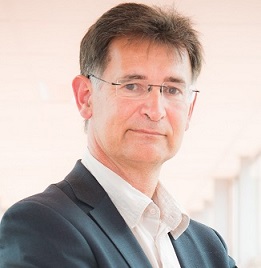
Jean-Marc Jézéquel
Professor of Software Engineering at Université de Rennes/Inria
Jean-Marc Jézéquel is a Professor of Software Engineering at the University of Rennes and a member of the DiverSE team at IRISA/Inria, as well as a fellow of the Institut Universitaire de France (IUF). Since 2024 he is President of Informatics Europe. From 2012 to 2020 he was Director of IRISA, one of the largest public research labs in Informatics in France. In 2016 he received the Silver Medal from CNRS and in 2020 the IEEE/ACM MODELS career award. He was an invited professor at McGill University in 2022. His interests include model driven software engineering for digital twins with quality of service constraints, including security, reliability, performance, timeliness etc. He is the PI of the French-German MBDO project to help build Digital Twins for Industry 5.0 in a DevOps way. He is the author of 4 books and of more than 300 publications in international journals and conferences.

Jannik Laval
Associate Professor at Université Lumière Lyon 2
Jannik Laval is an Associate Professor in Software Science at Université Lumière Lyon 2 and a member of the DISP laboratory since 2015. He heads the laboratory’s research group names TOOLS, participates on the laboratory’s board, and is active within the national community (as part of the EDT working group at the Scilog research group, and organising conferences dedicated to digital twins). He obtained his HDR in 2020 at the University of Lyon, as well as a PhD in Computer Science in 2011 at the University of Lille. His research focuses primarily on the lifecycle management of software systems, systems of systems engineering, software engineering applied to cyber-physical systems, digital twins and their federation. As the author or co-author of over 55 journal articles and international conference papers, he develops research projects with national and international partners (including Polytechnique Montréal), both academic and industrial. He co-leads PC2 DTCOMPOSE with Jean-Marc Jézéquel.
Participating Partners:


Project Implementation
The project is structured into three complementary work packages, addressing modular architecture, composition, and semantic interoperability.
Workpackage1: DT Reference Architecture
Leader: DiverSE (Inria/U. Rennes)
Partners: P4S (IMT), DISP (Univ. Lumière Lyon 2), UPPA
Objectives:
- Develop unified meta-data theory for variability, fidelity, and uncertainty management
- Establish reference architecture patterns for modular digital twin systems
- Create foundation for systematic composition and interoperability
Key Tasks:
- Define meta-data framework for DT characteristics
- Establish architectural patterns for modular DT design
- Develop guidelines for variability and uncertainty propagation
Workpackage2: DT Modularisation and Composability
Leader: P4S (IMT)
Partners: DiverSE (Inria/U. Rennes), DISP (Univ. Lumière Lyon 2), CIAD (U. de Bourgogne)
Objectives:
- Enable building DTs from pre-existing parts or through reverse engineering
- Support composition at design time (software components) and deployment time (Systems of Systems)
- Manage evolution including neuromorphic systems
Key Tasks:
- Develop component-based DT construction methodologies
- Create runtime composition and orchestration mechanisms
- Implement evolution management for adaptive systems
Workpackage3: DT Semantic Interoperability
Leader: Moex (Inria)
Partners: Wimmics (Inria), IRIT/SM@RT (Univ. Toulouse Jean Jaurès)
Objectives:
- Apply semantic web technologies for ontology alignment between independently designed DTs
- Improve and validate Knowledge Graph quality
- Maintain semantic tracks of digital twin experiments
Key Tasks:
- Develop ontology alignment methods for DT federation
- Create Knowledge Graph quality assessment frameworks
- Implement semantic tracking for DT interactions and experiments
Related publications
On the Challenges of Integrating Digital Twins
Benoît Combemale, Jörg Kienzle, Gunter Mussbacher, Pascal Archambault, Jean-Michel Bruel, Loli Burgueño, Betty H C Cheng, Loek Cleophas, Gregor Engels, Damien Foures, Stefan Klikovits, Vinay Kulkarni, Judith Michael, Sébastien Mosser, Houari Sahraoui, Eugene Syriani, Andreas Wortmann • 2025
Conference Paper • EDTconf 2025 - 2nd International Conference on Engineering Digital Twins
Engineering Digital Twins: A Research Roadmap
Benoît Combemale, Pascale Vicat-Blanc, Arnaud Blouin, Hind Bril El Haouzi, Jean-Michel Bruel, Julien Deantoni, Thierry Duval, Sébastien Gérard, Jean-Marc Jézéquel • 2025
Conference Paper • EDTconf 2025 - 2nd International Conference on Engineering Digital Twins
Towards a Unifying Reference Model for Digital Twins of Cyber-Physical Systems
Jérôme Pfeiffer, Jingxi Zhang, Benoît Combemale, Judith Michael, Bernhard Rumpe, Manuel Wimmer, Andreas Wortmann • 2025
Conference Paper • ETFA 2025 - 30th IEEE International Conference on Emerging Technologies and Factory Automation
Related positions
Composing DTs with Variability, Fidelity and Uncertainty
This PhD project aims to propose concepts, methods and tools to allow the composition of digital twins components with an explicit handling of Variability, Fidelity and Uncertainty.
- Master or Engineering degree in Software Engineering
- Experience with modeling (SySML, UML,...)
- +2 more requirements
Interconnection of digital twin knowledge
Digital twins will need to represent a variety of knowledge about territories and related data. It is therefore not possible to rely solely on a single unifying model, but must be able to interact with a variety of heterogeneous representations. This PhD project aims to manage the diversity of knowledge and viewpoints.
- Master degree in Software Engineering
- Experience with digital twins
Ongoing Research Positions
Federation of data and models to define digital twins
The digital twin is a repository of knowledge that must be modeled and constructed from highly heterogeneous sources of information. This heterogeneity has several sources: the nature of the information, but also its temporality (real time, futures, pasts). The aim of this thesis is to overcome this obstacle of heterogeneity.
Aggregation of digital twins in the manner of Systems of Systems
The goal is to develop a System of Systems approach from the design stage onwards. This will enable each component of the digital twin to be identified in relation to a physical system functionality, and their assembly will result in a complete digital twin through aggregation, whose lifecycle management will be controllable, just like the physical system.
Integration and synchronization of digital twins for co-simulation
This PhD project aims to propose a framework enabling the integration and synchronization of heterogeneous digital twins for reliable co-simulation. The objectives consist to consider how heterogeneous DT can be integrated into a coherent co-simulation framework.
Composing and Configuring Digital Twin Architectures to Meet User Requirements (Energy, Performance, Budget)
This PhD project investigates methods for composing and configuring digital twin architectures in order to meet user requirements under multiple non-functional constraints such as energy consumption, performance, and budget.