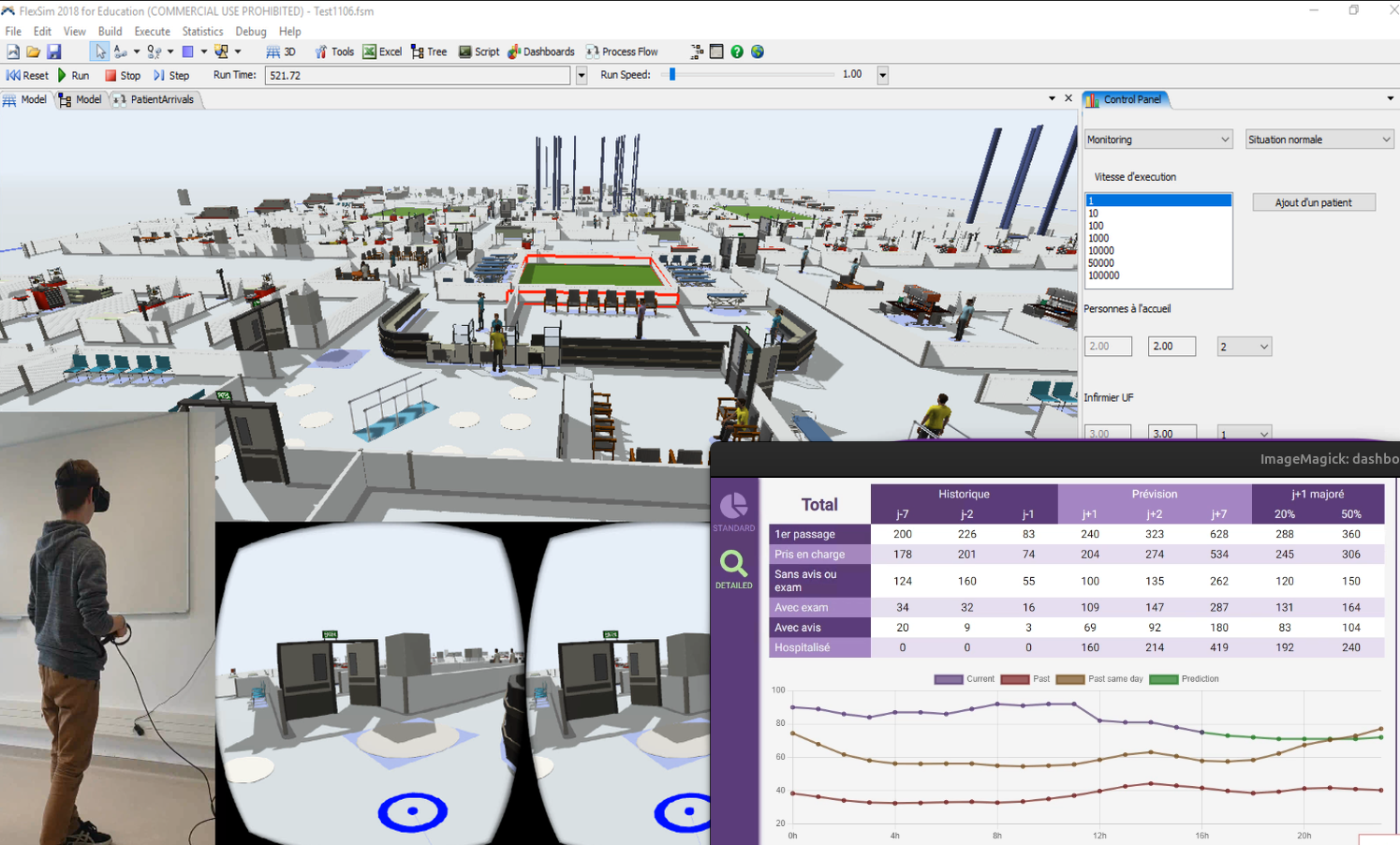
Care Process Digital Twin
Thierry Garaix (Mines Saint-Étienne)
Summary
The physical system under study is the hospital care pathway: the multistep process from admission to rehabilitation, combined with the working process of medical and paramedical resources (physicians, nurses, operating rooms, beds). Surgery, emergency care and cancer treatment are the main use cases.
The digital twin is a monitoring, prediction and decision-support software based on data analytics and detailed process models - a network of digital twins covering several care units and hospital partners. It supports simulation of future care-offer and demand scenarios, the design of optimised organisational configurations, fair and coordinated regulation of care pathways, and staff training for crisis or new organisational settings.
The use case is carried out with several hospital and research partners, including CHU Saint-Étienne, Hôpital Le Corbusier (Firminy), AÉSIO Santé, IMT Mines Albi-Carmaux and Télécom SudParis. Different versions are developed and tried out in situ depending on the service (operating room, emergency department) and the hospital partner.
Functional Description
Users
- A care pathway manager - monitors patient flow and resource load to organise care delivery.
- A hospital administrator / regulator - arbitrates organisational configurations and pathway regulation across units.
- A medical/paramedical staff member - is trained on crisis situations or new organisational settings via simulation.
- A researcher / process analyst - studies real patient pathways and resource usage to calibrate models.
Functional Requirements
-
Steer · A department head monitors activity in real time and is alerted to upcoming risks. Can anticipate the system’s evolution without action, or with managerial actions simulated within the system. Metric: gap between planned and observed activity, in both monitoring and simulation mode.
-
Predict + Optimise · A care pathway manager wants to simulate and evaluate future care-offer and demand scenarios to propose optimised organisational configurations, ahead of capacity-planning decisions. Metric: scenarios compared on resource load and pathway indicators (waiting time, occupancy).
-
Optimise + Describe · A hospital administrator wants to support a fair and coordinated regulation of care pathways across services to balance load between units, in day-to-day operations. Metric: reduction in pathway imbalance / waiting-time variance across units.
-
Diagnose · A researcher wants to analyse real patient pathways from indoor tracking and monitoring data to identify bottlenecks and calibrate simulation models, during model-development phases. Metric: patient pathways reconstructed and compared against modelled pathways.
-
Train + Describe · A medical/paramedical staff member wants to train on crisis or new organisational settings using detailed monitoring and simulation (including VR) to prepare for real operational changes, ahead of deployment. Metric: number of scenarios covered by training sessions.
Digital Twin Characterisation
Grid based on the unified framework by Gil et al. (2024) - 21 characteristics.
MC1 - System under study
The hospital care pathway: the multistep process from patient admission to rehabilitation, combined with the working process of medical and paramedical resources (physicians, nurses, operating rooms, beds, waiting areas). Surgery, emergency care and cancer treatment are the main use cases, situated within one or several hospital units (e.g. CHU Saint-Étienne, Hôpital Le Corbusier).
MC2 - Physical Acting Components
No direct actuator: the digital twin is decision-oriented. Outputs (recommendations, optimised configurations, training scenarios) are consumed by human operators - care pathway managers, administrators, staff.
MC3 - Physical sensing components
- Indoor tracking system - real-time patient and staff location within care units
- Hospital information systems - patient admission, discharge and transfer events, resource occupancy
MC4 - Physical-to-Virtual Interaction
Exploitation of the indoor tracking system and hospital process data to reconstruct real patient pathways and resource usage, feeding the monitoring and simulation models. Frequencies and formats to be specified.
MC5 - Virtual-to-Physical Interaction
No direct command on physical resources: the digital twin produces a real-time control dashboard, simulation results and optimised organisational configurations, consumed by care pathway managers and administrators.
MC6 - Digital Twin Services
- Real-time control dashboard of patient and resource load
- Detailed monitoring and discrete-event simulation of care units
- Simulation and evaluation of future care-offer and demand scenarios
- Proposal of optimised organisational configurations
- Staff training environment (including VR) for crisis or new organisational settings
- Analysis of real patient pathways from indoor tracking data
MC7 - Twinning Time-scale
Combines real-time monitoring (indoor tracking, control dashboard) with simulation of tactical/strategic scenarios (organisational configuration, capacity planning). Not a closed real-time control loop.
MC8 - Multiplicities
A network of digital twins: multiple care units and hospital partners (CHU Saint-Étienne, Hôpital Le Corbusier) are modelled, with the ability to coordinate across the network.
MC9 - Life-cycle Stages
Covers care-pathway operations (admission to rehabilitation) and organisational design/planning (evaluation of future configurations), as well as staff training.
MC10 - Digital Twin Models and Data
- Detailed process models of care units (discrete-event simulation)
- Data-driven models fed by real patient pathway analysis and indoor tracking
- Data: patient admission/discharge/transfer events, indoor location traces, resource occupancy
MC11 - Tooling and Enablers
Real-time control dashboard, detailed monitoring/simulation software, VR-based training environment, exploitation of an indoor tracking system.
MC12 - Digital Twin Constellation
Pipeline: indoor tracking and hospital data ingestion → analysis of real patient pathways → detailed process/simulation models → control dashboard, optimised configurations and VR training outputs. A network of digital twins coordinated across care units.
MC13 - Twinning Process and Digital Twin Evolution
Incremental approach built with hospital partners (CHU Saint-Étienne, Hôpital Le Corbusier) and research partners (IMT Mines Albi-Carmaux, Télécom SudParis). Details to be specified as the network of digital twins matures.
MC14 - Fidelity and Validity Considerations
Calibration against analysis of real patient pathways from indoor tracking data. Validation approach and error metrics to be specified.
MC15 - Digital Twin Technical Connection
Connection to the indoor tracking system and hospital information systems. Protocols to be specified.
MC16 - Digital Twin Hosting/Deployment
In the partner hospitals.
MC17 - Insights and decision-making
- Real-time control dashboard of care-unit load
- Optimised organisational configurations for care-offer and demand scenarios
- Fair and coordinated regulation recommendations across care pathways
- Training feedback for staff facing crisis or new organisational settings
MC18 - Horizontal integration
Involves multiple hospital partners (CHU Saint-Étienne, Hôpital Le Corbusier, AÉSIO Santé) and research partners (IMT Mines Albi-Carmaux, Télécom SudParis), coordinating a network of digital twins across care units.
MC19 - Data ownership and privacy
Patient pathway and location data are sensitive health data. Governance and regulatory compliance (health data protection) to be formalised across the hospital partners.
MC20 - Standardisation
To be specified.
MC21 - Security and Safety Considerations
Handling of sensitive patient data (location, pathway) requires access control and health-data protection measures. No direct control loop - operational safety risk limited to the decision-support scope.
Scientific and Technical Challenges
Each challenge is annotated with research questions (RQ_X) from the EDT research roadmap [Combemale et al., 2025].
Coordinating a network of digital twins
Coordinating the network of digital twins across care units and hospital partners, so that local optimisations remain consistent with global, fair and coordinated regulation of care pathways.
Associated RQs: RQ_C5 (federated access coordination), RQ_D10 (cross-DT data aggregation)
Data-driven combinatorial optimisation
Designing efficient data-driven combinatorial optimisation models and algorithms to propose optimised organisational configurations for complex, multistep care pathways with resource constraints.
Associated RQs: RQ_D8 (AI model training), RQ_T5 (quality properties per use case)
Automated model calibration
Automating the setting of models via Bayesian inference and reinforcement learning, to keep simulation and optimisation models aligned with observed care-pathway behaviour without extensive manual tuning.
Associated RQs: RQ_D6 (simulation model evolution), RQ_D9 (AI model CRUD interface)
FAIR access to historical and real-time data
Managing FAIR (Findable, Accessible, Interoperable, Reusable) access to historical and real-time care-pathway data - including sensitive indoor tracking and patient data - across the network of hospital partners.
Associated RQs: RQ_D3 (heterogeneous data collection), RQ_E5 (data security and traceability)
References
- Poster - Care process DT for complex demand with resource management - Thierry Garaix, Mines Saint-Étienne - Use Case Workshop, Lyon, 6-7 January 2026
- Combemale B., Vicat-Blanc P., Blouin A., Bril El Haouzi H., Bruel J.-M. et al. Engineering Digital Twins: A Research Roadmap. EDTconf 2025 - 2nd International Conference on Engineering Digital Twins, Oct 2025, Grand Rapids, Michigan, United States. pp.1-7. ⟨hal-05223776⟩ - scientific roadmap of the EDT programme (RQ_X codes).